

5 Reasons to Visit Matera, Italy
5 Reasons to Visit Matera, Italy
One of the oldest inhabited places on earth — a city not built on the land, but carved into it.
Most Italian hill towns sit on the rock. Matera is cut into it. For millennia, families lived in dwellings hollowed straight out of the limestone ravine — the Sassi — until the mid-20th century, when the government emptied them as a national embarrassment. Then the story reversed: the caves were restored, UNESCO listed them, and the place Italy was once ashamed of became one of its most extraordinary destinations. Here are five reasons that hold up in person.
You can sleep inside a cave that's thousands of years old
This isn't a themed hotel with fake stone. The rooms of Matera's cave hotels are the original dwellings — the same carved chambers where Materan families and their livestock sheltered for generations, now restored with underfloor heating, deep tubs, and beds set beneath vaulted rock ceilings. The temperature holds steady year-round because you're inside the mountain, not on top of it.
Waking in a room with no straight lines, lit by a single window cut through several feet of stone, is something you don't get anywhere else in Europe.
Look for the albergo diffuso model — a "scattered hotel" where rooms are spread across restored caves rather than stacked in one building.
The Sassi are a working lesson in ancient ingenuity
Look past the postcard view and the Sassi reveal themselves as one of the most sophisticated water systems of the pre-modern world. The city is threaded with cisterns and channels carved to capture and store every drop of rain in a dry region — including the Palombaro Lungo, an enormous underground reservoir beneath the main square that you can walk down into.
Guides who grew up here explain how a roof was also someone's terrace, a street was also a drainage channel, and a home's back wall was solid bedrock. It reframes the whole city from "pretty ruins" to a place people solved hard problems for thousands of years.
Rock churches hide Byzantine frescoes in the dark
Scattered through the Sassi and the ravine across from it are dozens of chiese rupestri — churches carved into the rock, some over a thousand years old, their walls still holding faded Byzantine frescoes. They're small, cool, and often nearly empty, which is the point: you can stand alone in a candle-dim chapel hewn from stone and look at a saint's face painted before most of Europe's cathedrals existed.
The ravine opposite the city, the Murgia, holds many of these and rewards a half-day hike with silence and long views back at the Sassi.
Basilicata's food is Italy without the markup
Matera anchors one of Italy's most under-visited food regions, and the cooking is cucina povera at its best — peasant food elevated by great ingredients. The signature is pane di Matera, a tall, deeply crusted sourdough with IGP protected status, traditionally baked large enough to last a family a week. Around it: orecchiette with turnip tops, fiery peperoni cruschi, and lamb from the surrounding hills.
You eat well here for a fraction of what the same meal costs in Tuscany or on the Amalfi Coast — often in a dining room that's itself a cave.
Puglian and Basilicata wines are the other reason to linger over dinner.
It's a cinematic landscape you've already seen
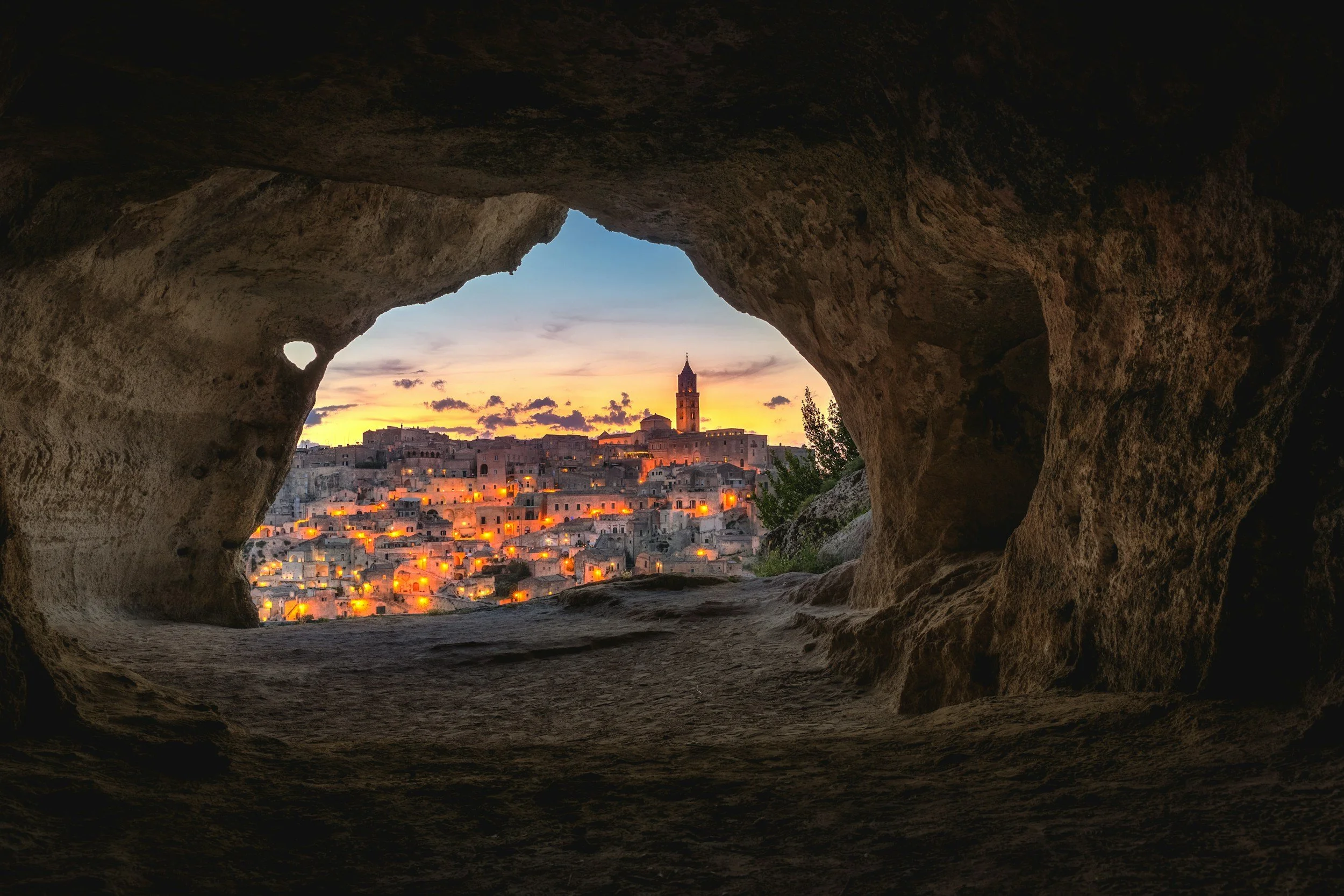
Matera's stone cityscape reads as ancient Jerusalem on film, which is why directors keep bringing biblical and period epics here — its timeless, unmarked-by-modernity look is genuinely hard to find. Walking the Sassi at dusk, when the limestone goes gold and lamplight fills the carved windows, you understand why: there's almost nothing in the frame to tell you what century it is.
Go up to a belvedere at sunset with the whole city stacked below you. It's the view that sells the trip, and it earns it.
Plan your trip to Matera
Getting there
Fly into Bari, roughly an hour away, then continue by car or regional transit. A rental car gives the most freedom to explore Basilicata and neighboring Puglia.
Where to stay
Choose a restored cave hotel in the Sassi. Sassi Barisano and Sassi Caveoso are the two historic districts to base yourself in.
Best time to visit
Spring (April–June) and early autumn (September–October) bring mild weather and thinner crowds. Summer is hot and busy; winter is quiet and atmospheric.
How long to stay
Two nights lets you see the Sassi, the rock churches, and the Murgia ravine without rushing — and catch both a sunset and a sunrise over the stone.
Matera travel FAQ
What is Matera known for?
The Sassi, districts of dwellings, churches, and cisterns carved directly into limestone. Matera is one of the oldest continuously inhabited settlements in the world and a UNESCO World Heritage Site.
Can you stay in a cave in Matera?
Yes. Many original cave dwellings have been restored into hotels and guesthouses, letting visitors sleep inside the same carved-stone rooms families lived in for generations.
When is the best time to visit Matera?
Spring (April to June) and early autumn (September to October) offer mild weather and thinner crowds. Summer can be hot and busy; winter is quiet and atmospheric.
How do you get to Matera?
Matera has no major airport of its own. Most travelers fly into Bari, about an hour away, and continue by car or regional transit.
More of Southern Italy
5 Reasons to Visit Matera, Italy