5 Reasons to Visit® · United States
Why People Are Moving to Duluth, the Freshwater City on Lake Superior
On the shore of the largest freshwater lake on earth, a rugged port city has become one of the most talked-about places to move in America — for reasons that reach decades into the future.
Advertisement
Duluth, Minnesota, sits at the westernmost tip of the Great Lakes, a rugged port city built on hills that tumble down to the shore of Lake Superior — the largest freshwater lake on earth. For generations it was known mainly as a working harbor, shipping iron ore and grain out to the world, and as a summer escape for Minnesotans looking to trade humidity for lake breezes. In recent years it has taken on a very different reputation, one that reaches decades into the future: Duluth has become one of the most talked-about places to move in America, a city increasingly described as a climate haven.
Advertisement
The reason begins with the lake. Lake Superior holds roughly ten percent of the planet's fresh surface water and exerts a powerful moderating effect on the local climate, tempering summer heat in a way that has drawn national attention — features in outlets from CNN to The New York Times, and a steady trickle of new residents from places threatened by heat, drought, and fire, part of the broader lake-town draw seen in places like Traverse City, Michigan. In an era of water scarcity elsewhere, a city with abundant fresh water and cooler summers has become genuinely magnetic. It is worth noting, as local climatologists do, that no city is truly "climate-proof" — Duluth is warming and wetting too — but its relative resilience is real and increasingly valued.

What makes Duluth livable rather than merely theoretical is its outdoor culture. The city boasts some 10,000 acres of public land and more than 200 miles of hiking and mountain-biking trails, including a stretch of the epic Superior Hiking Trail, along with the beloved Lakewalk tracing the shore. Jay Cooke State Park, the dramatic North Shore, and the wilderness of the Boundary Waters are all close at hand. Winter turns the whole region into a cold-weather playground rather than a season to endure.
Ten percent of the world's fresh water, two hundred miles of trails, and a lake that never lets the heat win.
Advertisement
The economy has diversified to support the lifestyle. Beyond the still-working port, Duluth's job base now leans on healthcare, education, aviation, and a growing tech and startup scene, anchored by major employers like the Essentia Health system and Cirrus Aircraft. It is a real economy, not just a tourist one, giving newcomers something to build a livelihood around — and the craft-beer culture that has blossomed along the waterfront (helped, brewers swear, by that famously pure Lake Superior water) is a happy byproduct.
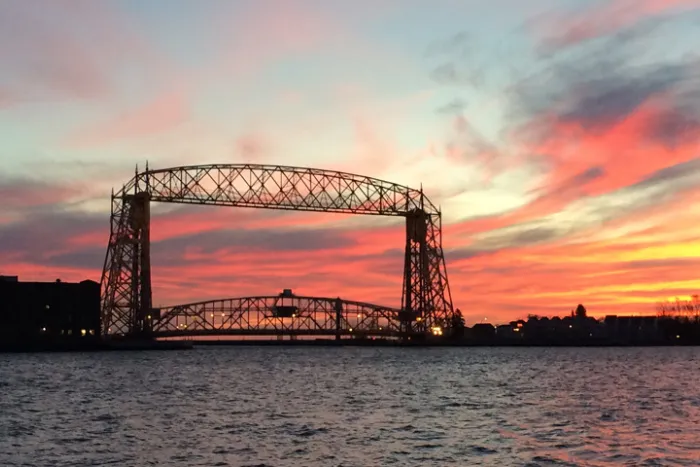
Downtown and the Canal Park waterfront tie it together. The area around the iconic Aerial Lift Bridge has been revitalized into a walkable district of breweries, restaurants, and shops along the lake, and the city's cost of living remains modest compared with larger metros, with genuinely affordable housing by national standards. For people seeking a scenic, outdoorsy, freshwater-rich city that still makes financial sense, Duluth checks an unusual number of boxes.
That very appeal is beginning to create pressure, and locals name it honestly — a hot real estate market and an aging housing stock have raised real worries about affordability if climate migration accelerates, and the city is candid about the need to build. But the underlying draw is powerful and forward-looking. Abundant fresh water, hundreds of miles of trails, a walkable waterfront, a diversified economy, and genuine climate resilience have made Duluth one of the most intriguing small cities in America. For the visitor it makes a rugged, beautiful lakeside escape. For the growing number who choose to stay, it makes the case for a life anchored to the largest freshwater lake on earth — which is exactly why they keep arriving.
Duluth, Minnesota: FAQ
Is Duluth, Minnesota worth visiting?
Yes. Duluth offers a walkable Canal Park waterfront on Lake Superior with the iconic Aerial Lift Bridge, breweries and restaurants, the scenic Lakewalk, and more than 200 miles of hiking and mountain-biking trails, with the North Shore, Jay Cooke State Park, and the Boundary Waters nearby. It makes a rugged, beautiful lakeside escape in any season.
Why are people moving to Duluth, MN?
Duluth has drawn national attention as a 'climate haven' thanks to Lake Superior — which holds about 10% of the world's fresh surface water and moderates summer heat — along with abundant outdoor recreation, a diversified economy, a walkable waterfront, and affordable housing by national standards. Newcomers include people relocating from areas threatened by heat, drought, and fire.
Is Duluth a good place to live?
Duluth ranks among the best places to live in Minnesota for its natural beauty, outdoor access, affordability, low crime, and diversified economy in healthcare, education, aviation, and tech. Winters are long and cold, and a rising real estate market has begun to pressure affordability, but housing remains attainable by national standards.
What is Duluth known for?
Duluth is known as a port city on Lake Superior, the largest freshwater lake on earth, for its 'climate haven' reputation, the Canal Park waterfront and Aerial Lift Bridge, more than 200 miles of trails including part of the Superior Hiking Trail, a growing craft-beer scene, and employers like Cirrus Aircraft and Essentia Health.
Advertisement