How Binghamton, the Carousel Capital, Found Its Second Spin
5 Reasons to Visit® · United States
How Binghamton, the Carousel Capital, Found Its Second Spin
A faded industrial city at the meeting of two rivers — birthplace of the flight simulator and the spiedie — is quietly spinning back to life.
Advertisement
Binghamton, New York, sits where the Chenango River meets the Susquehanna, at the heart of the Southern Tier near the Pennsylvania line. For much of the twentieth century this was a serious industrial city — a cradle of innovation where the flight simulator was invented, where IBM traces part of its roots, and where the Endicott-Johnson shoe empire built a whole paternalistic company culture along the rivers. When that industrial base eroded, Binghamton, like so many Rust Belt cities, faced decades of decline. Lately, though, "Bing" has been finding its second spin.
Advertisement
Its most charming inheritance is literal: carousels. Binghamton calls itself the "Carousel Capital of the World," home to six antique wooden carousels donated by shoe magnate George F. Johnson, all lovingly restored and — in keeping with Johnson's original wish — completely free to ride. Scattered through the city's parks, they are a delightful, nostalgic emblem of a place that built things to last and is now rediscovering its own charm.
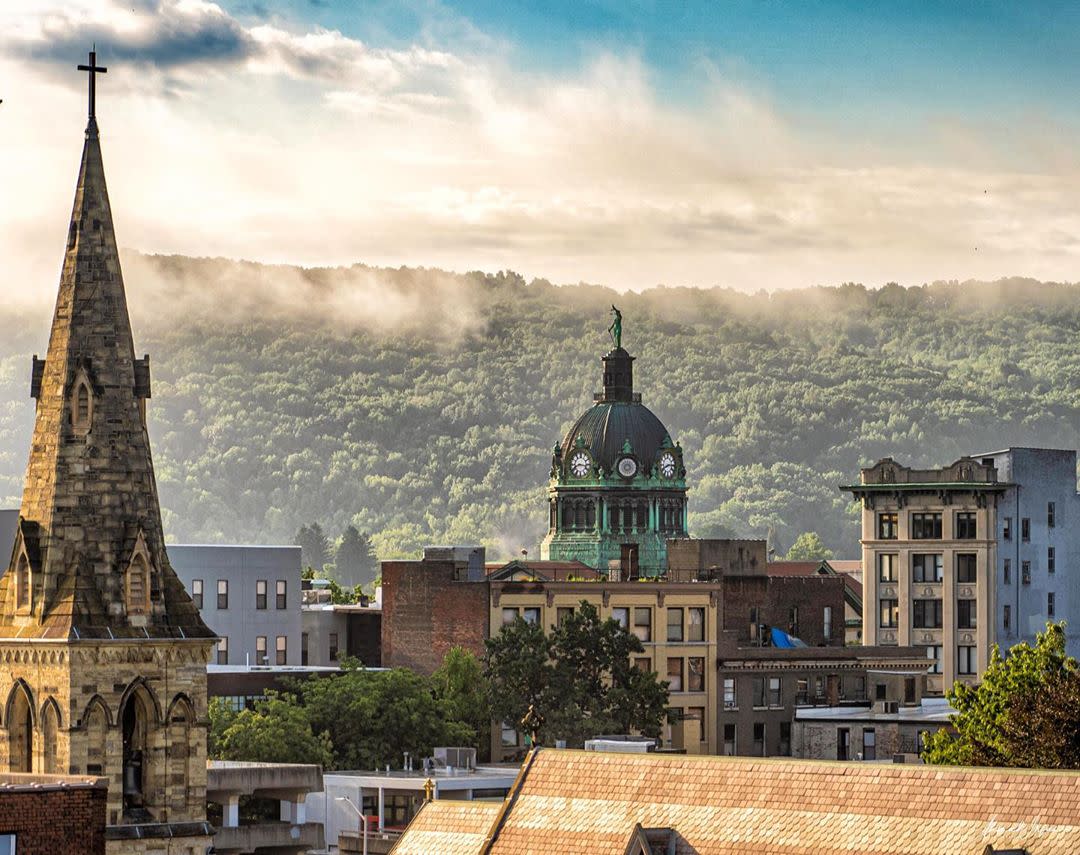
The engine of the comeback is up the hill in neighboring Vestal: Binghamton University, one of the State University of New York's four research centers and widely regarded as a "Public Ivy." With roughly eighteen thousand students and a growing research profile, the university is the region's economic anchor, feeding a small but real innovation economy and bringing a steady influx of young people, talent, and energy to a downtown that has been slowly filling back in with restaurants, breweries, and apartments.
Six antique carousels, all free to ride, in a city that helped invent the modern world.
Advertisement
Binghamton's culture has a distinctive flavor — quite literally. This is the birthplace of the spiedie, cubes of marinated meat grilled and served on a roll, a hyper-local delicacy celebrated each summer at the Spiedie Fest and Balloon Rally. The city also hosts the LUMA Projection Arts Festival, which turns downtown's historic facades into enormous canvases of light, along with jazz and blues festivals and a year-round farmers market — a cultural life richer than the city's size or reputation would suggest.
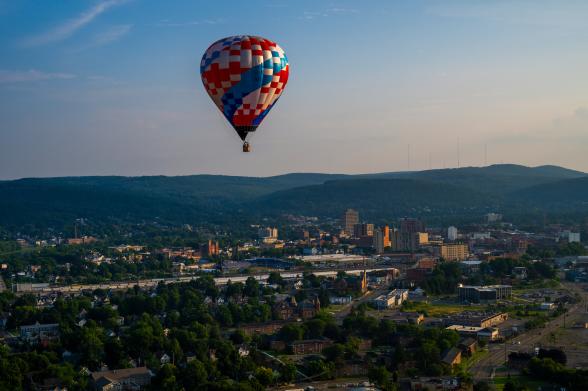
Value and setting drive the renewed interest. Binghamton offers genuinely affordable housing by New York standards, a walkable historic downtown, and immediate access to the rolling hills, rivers, and state parks of the Southern Tier for hiking, paddling, and fishing. As housing costs have soared across much of the Northeast, the city's combination of a university-anchored economy, low cost of living, and outdoor access has drawn students who stay, remote workers, and families seeking a foothold in New York without a downstate price tag.
Binghamton still carries the honest scars of its industrial decline, and its revival is a work in progress rather than a finished story. But the momentum is real. Free antique carousels, a rising research university, a one-of-a-kind food culture, and Southern Tier affordability have given the Carousel Capital a genuine second act. For the visitor it makes a nostalgic, surprising stop. For the growing number who choose to stay, it makes the case for a comeback city that never stopped knowing how to build things — which is exactly why they keep discovering it.
Binghamton, New York: FAQ
Is Binghamton, New York worth visiting?
Yes. Binghamton is the 'Carousel Capital of the World,' with six free antique carousels, plus a distinctive food culture built around the spiedie, festivals like Spiedie Fest and the LUMA Projection Arts Festival, a walkable historic downtown, and access to the rivers and hills of the Southern Tier. It makes a nostalgic and surprising stop.
Why are people moving to Binghamton, NY?
Binghamton offers genuinely affordable housing by New York standards, a walkable downtown, and a university-anchored economy centered on Binghamton University (a 'Public Ivy'), plus Southern Tier outdoor access. As housing costs soar across the Northeast, it draws students who stay, remote workers, and families seeking a foothold in New York without a downstate price tag — much like neighboring Vestal, New York.
What is Binghamton known for?
Binghamton is known as the 'Carousel Capital of the World' for its six free antique carousels, as the birthplace of the spiedie and the flight simulator, for Binghamton University, and for festivals like Spiedie Fest and Balloon Rally and the LUMA Projection Arts Festival. It sits at the meeting of the Chenango and Susquehanna rivers.
Is Binghamton a good place to live?
Binghamton offers affordable housing by New York standards, a walkable historic downtown, a strong university-anchored economy, and access to Southern Tier rivers and hills. Like many post-industrial cities, its revival is a work in progress, but its affordability and Binghamton University make it an increasingly appealing value.
Advertisement