The Vanishing Chesapeake Island Where They Still Speak an Old-World Brogue
5 Reasons to Visit® · United States
The Vanishing Chesapeake Island Where They Still Speak an Old-World Brogue
A 1.3-square-mile speck in the middle of the Chesapeake, reachable only by boat or plane, Tangier Island is a crabbing community with its own old-world accent — and it's slowly slipping beneath the bay, which is exactly why to go now.
Advertisement
Tangier Island, Virginia, is one of the most singular places left in America — and one of the most fragile. A speck of marsh and sand barely a mile wide and three miles long, sitting alone in the middle of the Chesapeake Bay and reachable only by ferry or small plane, this crabbing community of around four hundred souls feels like nowhere else in the country. Its residents speak a centuries-old dialect all their own, get around by golf cart, and make their living from the water the way their ancestors have for generations. And it is slowly, genuinely disappearing beneath the bay — which is precisely why so many people are making the trip now.
Advertisement
Its accent is the thing that stops visitors cold. Settled by English colonists in the 1600s and isolated ever since, Tangier developed a distinct brogue that linguists trace back to Elizabethan-era English, with echoes of Cornwall braided into a Southern drawl — a way of speaking found nowhere else on earth. Old surnames like Crockett, Parks, and Thomas still fill the island, descendants of the original settlers, and hearing the watermen banter across the harbor is like listening to a living piece of the seventeenth century.
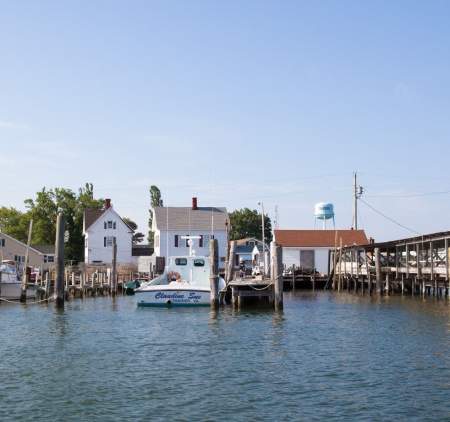
Crabbing is the island's heartbeat. Tangier is known as the "Soft Crab Capital of the World," and it earns the title — a huge share of the nation's soft-shell crabs come from the surrounding Tangier Sound. The harbor is lined with weathered crab shanties built on stilts over the water, where watermen shed the soft-shells through the summer, and traditional Chesapeake deadrise workboats crisscross the channels heading out to the crabbing grounds and back. Watching the daily catch come in is the island's great free show.
Its own Elizabethan-tinged brogue, the soft-crab capital, and a way of life slipping beneath the bay.
Advertisement
Life here moves at the pace of the tides. With dry land at a premium and the streets barely wide enough for a golf cart, most islanders get around by cart or bicycle, and visitors do the same — cycling the compact lanes at sunset is the perfect way to see it. The Tangier History Museum tells the island's story, a pristine wild beach edges the marsh, kayak nature trails wind through the wetlands, and local eateries serve some of the freshest crab you will ever eat, straight from the boats.
The history runs deep for such a small place. Tangier has been a recognized curiosity for over a century — President Woodrow Wilson once stepped off his yacht in 1916 simply to walk the main street and see it for himself. The island played a role in the War of 1812, and its tight-knit, deeply religious community has held onto its traditions with remarkable tenacity, a genuine folk culture surviving in the middle of the modern Chesapeake.
But Tangier is honest, unavoidably, about the shadow over it: the island is sinking. Erosion and rising seas have already claimed much of its land, the population is shrinking, and scientists warn it could become uninhabitable within decades — a poignancy that hangs over every visit. That fragility is part of what makes it so moving. A one-of-a-kind old-world brogue, the soft-crab capital, stilt-built shanties, and a vanishing way of life have made Tangier Island one of the most extraordinary places in America to visit. For the traveler it offers a genuine step back in time; for anyone who wants to witness a disappearing world while it's still here, there is nowhere quite like it — and no guarantee how long there will be.
Tangier Island, Virginia: FAQ
Is Tangier Island, Virginia worth visiting?
Yes — it's one of the most unique places in America. Tangier Island is a tiny, remote crabbing community in the middle of the Chesapeake Bay, reachable only by ferry or small plane, where residents speak a centuries-old dialect, get around by golf cart, and work the water as the 'Soft Crab Capital of the World.' Visitors can tour crab shanties, bike the lanes, visit the Tangier History Museum, walk a wild beach, and eat exceptionally fresh seafood.
Why is Tangier Island sinking?
Tangier Island is losing land to a combination of erosion, land subsidence, and rising sea levels in the Chesapeake Bay. Much of the island's original land has already disappeared, its population has been shrinking, and scientists have warned it could become uninhabitable within decades — making it one of the most cited examples of an American community threatened by a changing coastline.
Why do Tangier Island residents have an unusual accent?
Because of centuries of isolation. Tangier was settled by English colonists in the 1600s and remained cut off in the middle of the Chesapeake Bay, so it developed a distinctive dialect that linguists link to Elizabethan-era English with Cornish influences, blended with a Southern drawl. This brogue, found nowhere else, is one of the island's most famous features.
How do you get to Tangier Island?
Tangier Island is accessible only by boat or small plane. Passenger ferries run seasonally (roughly spring through fall) from Reedville and Onancock, Virginia, and from Crisfield, Maryland, and a mail boat also serves the island. There's a small airstrip for private aircraft. Once there, visitors get around on foot, by bicycle, or by golf cart.
Advertisement