5 Reasons to Visit® · Maryland
5 Reasons to Visit Annapolis, Maryland, Where George Washington Gave Up Power
In December 1783, George Washington walked into the Maryland State House and resigned his command, handing power back to Congress. In America’s 250th year, Annapolis is the place to see where that happened, then go sailing on the Chesapeake.
Advertisement
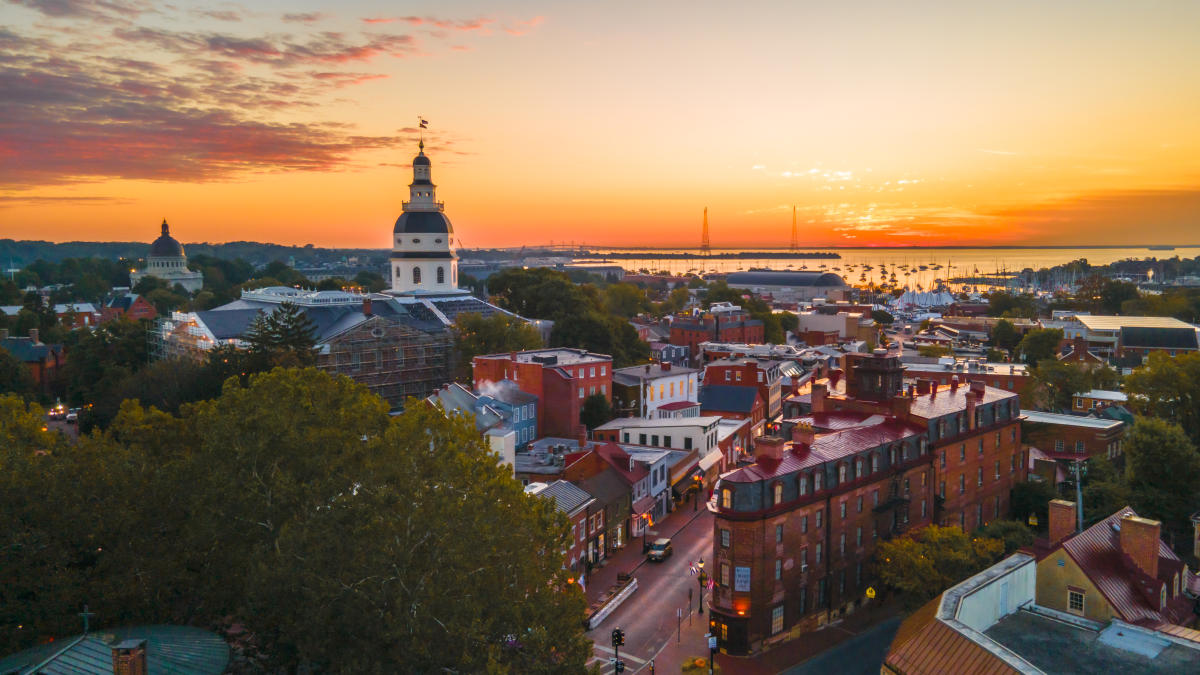
Annapolis, Maryland, has been the capital since 1694, and its State House is the oldest state capitol still in continuous legislative use. From November 1783 to August 1784, Annapolis served as the capital of the United States, and it was here, on December 23, 1783, that George Washington resigned his commission as commander-in-chief, establishing civilian control of the military. In 2026, as the country marks its 250th anniversary, the city’s colonial streets, the U.S. Naval Academy and its sailboat-filled harbor make it one of the most rewarding history trips on the East Coast. Here are five reasons to visit.
Advertisement
1Things to See & Do
Things to Do in Annapolis: The Maryland State House and the Naval Academy
The Maryland State House, topped by a wooden dome billed as the largest in the country built without nails, served as the U.S. capitol in 1783 and 1784. Visitors can see the Old Senate Chamber, where Washington resigned his commission and where Congress ratified the Treaty of Paris, which ended the Revolutionary War. Admission is free; bring photo identification.
The U.S. Naval Academy welcomes visitors with guided tours from its visitor center, including the chapel, whose crypt holds the remains of John Paul Jones, and the Naval Academy Museum. Real ID-compliant identification is required for adults. In the historic district, the William Paca House and Garden, home of a signer of the Declaration of Independence, and the Kunta Kinte–Alex Haley Memorial at City Dock round out a day of history.
2Dining Scene
Where to Eat in Annapolis: Chesapeake Crabs and Colonial Taverns
Maryland blue crabs, steamed and dusted with Old Bay, are the essential Annapolis meal in summer and early fall, along with crab cakes, cream of crab soup and rockfish. Across the harbor in Eastport, waterfront restaurants such as Carrol’s Creek and O’Leary’s Seafood serve Chesapeake classics with views of the boats.
In the historic district, colonial-era taverns such as Middleton Tavern and Reynolds Tavern carry on traditions dating to the 1700s, and Main Street and Maryland Avenue are lined with cafés, pubs and bistros.
Annapolis is the rare historic town that is also a working waterfront: colonial brick, Navy whites and a harbor full of sails.
Advertisement
3Recreation
Outdoor Annapolis: Sailing the Chesapeake in America’s Sailing Capital
Annapolis calls itself America’s Sailing Capital, and the best way to see it is from the water. Take a schooner cruise or a sailing lesson, or watch the Wednesday night races in summer, when dozens of boats race off the harbor. Each October, the city hosts the United States Sailboat Show and Powerboat Show, among the largest in-water boat shows in the world.
On land, Quiet Waters Park has trails and kayak rentals on the South River, Sandy Point State Park offers a beach with views of the Chesapeake Bay Bridge, and the Baltimore and Annapolis Trail runs north for bikers and runners.
4Shopping
Shopping in Annapolis: Main Street, Maryland Avenue and Nautical Finds
Main Street, running from Church Circle down to City Dock, is lined with boutiques, nautical and Naval Academy shops, galleries and candy stores. Maryland Avenue, near the State House, has antiques, home décor and independent shops in historic buildings.
West Street, the city’s arts district, adds galleries and local makers, and Eastport’s maritime shops are full of sailing gear and nautical gifts.
5Art & Culture
Annapolis’s Art Scene: Colonial Architecture, Maryland Hall and West Street
Annapolis has one of the largest concentrations of 18th-century buildings in the country, and its Georgian mansions, including the Hammond-Harwood House, are considered masterpieces of colonial American architecture. The Banneker-Douglass-Tubman Museum celebrates African American history and culture in Maryland.
Maryland Hall for the Creative Arts hosts the Annapolis Symphony, ballet, opera and exhibitions, and the Mitchell Gallery at St. John’s College presents fine art exhibitions. West Street’s galleries and murals anchor the city’s Arts District.
Plan Your Annapolis Trip
Annapolis is at its best from May through October, with sailing, crab feasts and the October boat shows. Give it two days: one for the State House, the Naval Academy and the historic district, and one on the water, followed by crabs in Eastport. Through the end of 2026, look for America 250 events across the city, and bring photo ID for the State House and Naval Academy.
Annapolis, Maryland: FAQ
Is Annapolis, Maryland worth visiting?
Yes. Annapolis offers the Maryland State House, where George Washington resigned his commission, the U.S. Naval Academy, colonial architecture, Chesapeake Bay sailing, Maryland blue crabs and a walkable historic district, all within an hour of Washington, D.C., and Baltimore.
Was Annapolis ever the capital of the United States?
Yes. Annapolis served as the capital of the United States from November 1783 to August 1784, when the Confederation Congress met in the Maryland State House.
Where did George Washington resign his commission?
George Washington resigned his commission as commander-in-chief of the Continental Army on December 23, 1783, in the Old Senate Chamber of the Maryland State House in Annapolis.
Can you visit the U.S. Naval Academy?
Yes. The U.S. Naval Academy offers guided tours from its visitor center. Adult visitors must present Real ID-compliant identification.
What are the best things to do in Annapolis?
Top things to do in Annapolis include touring the Maryland State House and the U.S. Naval Academy, visiting the William Paca House and Garden, sailing on the Chesapeake Bay, eating steamed crabs in Eastport, and shopping on Main Street and Maryland Avenue.
When is the best time to visit Annapolis?
May through October is the best time to visit Annapolis, with sailing season, crab season and the October boat shows.
When did Annapolis become the capital of Maryland?
Annapolis became the capital of Maryland in 1694, when the colonial government moved from St. Mary’s City.
Advertisement